Additionally, check out our Cabinet Refacing buying guide, which shows how you can update the look of your kitchen by replacing cabinet fronts and veneering cabinet exteriors without the inconveniences associated with a major renovation. It's a cost-effective option that will ultimately save you time and money.
Stock, Semi-Custom or Custom
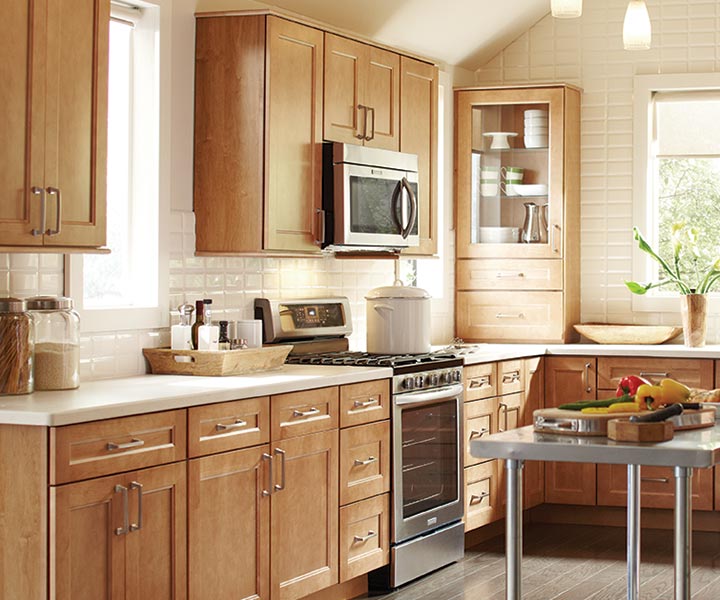
A good starting point in selecting your cabinets is to determine the options, availability and specialization your kitchen project timeframe and budget requires, then decide if stock, semi-stock or custom cabinets best suit your needs.
Stock – These cabinets offer economical pricing, a wide range of standard sizes, styles and finishes and are often available the same day or within a few days of purchase. Stock cabinets typically offer some options for specialty functions, and can be an ideal solution for projects with limited budgets. They are often built in widths of 3” increments ranging from 12” to 60” wide. Standard heights range from 30”-36” with above-stove cabinets in heights of 12”-18”.
Semi-Custom – These cabinets offer more flexible options for storage, design and style as well as a wider selection of wood and finish choices. Semi-custom cabinets offer more functionality, with enhancements such as pull-out shelves, lazy Susans and vertical dividers, to name just a few. They usually require a longer lead time for delivery and are priced in the mid-range. Available sizes are typically the same as those for stock cabinets.
Custom – These cabinets are constructed by hand to fit your kitchen to your specifications. Custom cabinets make use of all available space and are an ideal solution when non-standard sizes are needed to fit irregular-shaped spaces. Delivery time can take up to nine or more weeks, depending on the cabinet maker’s schedule. The most expensive of the three options, they typically feature high-quality materials and construction features. Custom cabinets can be built in increments up to 1/32”. Price varies based on size, materials and options.
Construction
Understanding cabinet construction and knowing a few basic features to look for can go a long way in helping you match cabinets to your décor, lifestyle and budget.
Framed or Frameless
There are two basic styles of cabinets: framed and frameless. While both of these cabinet types share similar construction, the difference lies primarily in their appearance and the amount of storage they provide.
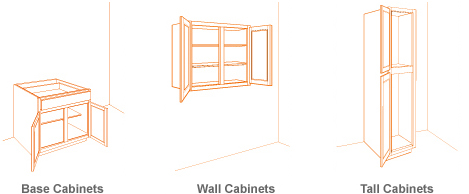
Framed cabinets, also known as face-framed cabinets, have a frame on the front of the cabinet that makes the box highly stable and helps keep it square. Door hinges attach to the frame. Framed cabinets complement both traditional and contemporary décor.
Frameless cabinets, also known as European-style cabinets, have no frame around the face of the cabinet box. Thicker side panels lend stability, and drawers and hinges attach directly to the cabinet’s side walls. Because drawers do not have to fit in a frame’s opening, they can be as wide as the cabinet, providing more storage. Frameless cabinets are often used with contemporary décor.
Materials
While you might think cabinets are made solely of wood, they are often constructed from other materials or combinations of materials as well. These materials are often combined to provide cost-effective, high-quality durability for the parts of your cabinet that are typically unexposed or behind the scenes. Materials commonly used for cabinet boxes and shelves include:
Particleboard – This material is made of wood chips or shavings bonded together with resin and compressed into rigid sheets. An economical alternative to solid wood, particleboard is very stable and is often used in stock cabinets as an underlayment for plastic laminates and wood veneers in the panels for the box and shelving. Particleboard doesn’t warp, shrink or swell due to humidity, but should be properly sealed to avoid moisture. Particleboard is assembled using glue or mechanical fasteners.
Medium Density Fiberboard (MDF) – An engineered wood made from fine wood particles and glue formed into sheets, MDF is often used as a backing material for laminates and other finishes. MDF is very dense, resists warping and has a smooth surface suitable for veneers, laminates and paints. It is often used in mid-priced cabinetry. Strong and durable, MDF provides many effective benefits for limited budgets.
Plywood – This engineered wood is composed of layers of veneers stacked and glued together with alternate layers oriented at right angles, providing strength in its length and width. Furniture-grade plywood is used in custom cabinetry. Because heat and moisture cause wood to expand and contract in the direction of the grain, plywood’s cross-grain pattern makes it more stable and stronger than solid wood. Plywood is often used for cabinet boxes and shelves in higher-priced cabinetry.
Follow this Home Depot Coupon 10% and get up to 20% OFF select Kitchen Cabinets! Limited time only!

No comments:
Post a Comment